Content
For industrial ventilation, the backward-curved centrifugal blower delivers the best balance of efficiency, stability, and noise control — achieving peak total efficiency of 80% to 85% in real-world installations. Efficiency gains of 10% to 25% are routinely achieved through variable frequency drive (VFD) integration and aerodynamic impeller upgrades. For corrosive environments, fiberglass-reinforced plastic (FRP) and duplex stainless steel are the proven material choices. Explore the full engineering rationale below.
Browse our range of centrifugal blower solutions engineered for demanding industrial environments.
Industrial ventilation demands a blower that maintains stable airflow across varying system resistances, operates quietly enough for occupied facilities, and sustains efficiency over long duty cycles. Three impeller geometries dominate this space — and the right choice depends on static pressure requirements and the nature of the airstream.
| Impeller Type | Peak Efficiency | Static Pressure | Best Application |
|---|---|---|---|
| Backward-Curved (BC) | 80% – 85% | Medium to High | HVAC, clean air ventilation, fume exhaust |
| Backward-Inclined (BI) | 75% – 82% | Medium | General industrial ventilation, dust-free air |
| Radial Tip (Paddle) | 60% – 70% | High | Particulate-laden air, heavy dust, chips |
| Forward-Curved (FC) | 60% – 72% | Low to Medium | Low-resistance HVAC supply, light-duty OEM |
| Airfoil (AF) | 85% – 90% | Medium to High | Large-scale clean air systems, power stations |
The backward-curved impeller is non-overloading — its power curve flattens toward maximum flow, preventing motor burnout if system resistance drops unexpectedly. This is a critical safety advantage in ductwork systems where dampers or filters are periodically removed for maintenance. A study of 120 industrial ventilation retrofits in the manufacturing sector found that backward-curved blowers reduced motor failures by 34% compared to forward-curved equivalents over a 5-year service window.
Airfoil impellers achieve 85% to 90% total efficiency — the highest of any centrifugal design — but require clean, dry air free from particulates above 50 mg/m3. Blade buildup from dust or moisture causes asymmetric loading and vibration, accelerating bearing failure. For power plant forced-draft and induced-draft service on clean flue gas, airfoil is the correct selection. For general factory ventilation where air quality is uncontrolled, backward-curved is safer and more durable.
When the airstream carries abrasive dust, wood chips, grain, or fibrous material, efficiency becomes secondary to durability. Radial tip (paddle wheel) impellers sacrifice 15 to 20 efficiency points but offer a simple geometry that self-cleans and resists blade wear. Industrial woodworking facilities, grain handling, and cement plants standardize on radial tip designs specifically for this reason.
Centrifugal blowers in industrial plants routinely operate at 55% to 65% of their peak design efficiency due to oversizing, fixed-speed drives, and degraded system components. Closing this gap is one of the highest-return energy investments available in facility management — blower and fan systems account for up to 25% of industrial electrical energy consumption in process-intensive industries.
The most impactful single intervention. Because blower power scales with the cube of speed (the fan affinity law), reducing speed by 20% cuts power consumption by nearly 49%. A 75 kW blower running at 80% speed uses approximately 38 kW — a reduction of 37 kW per operating hour. Across 8,000 annual operating hours, this represents over 290 MWh saved from a single unit.
Replacing a worn or geometrically outdated impeller with a precision-machined backward-curved or airfoil blade can recover 8% to 15% efficiency without replacing the entire blower housing. Blade erosion of just 2 mm on the leading edge of an airfoil impeller has been measured to reduce efficiency by up to 6% — systematic inspection intervals of 4,000 hours are recommended in abrasive environments.
Inlet guide vanes (IGVs) allow flow modulation without speed reduction — suitable for systems where VFD retrofitting is cost-prohibitive. Proper inlet duct design (straight run of at least 5 duct diameters before the blower inlet) reduces turbulence-induced losses. Poorly configured inlet elbows alone can reduce blower performance by 10% to 18% compared to ideal straight-run conditions.
Many industrial blowers are oversized because system designers apply excessive safety margins during initial specification. A system resistance audit — measuring actual static pressure at the blower discharge under real operating conditions — frequently reveals that actual resistance is 20% to 35% lower than design assumptions. Downsizing or re-trimming the impeller to match actual resistance brings the blower closer to its best efficiency point (BEP).
Shaft seal leakage and bearing friction are invisible efficiency drains. A worn mechanical seal on a 55 kW blower can leak 3% to 7% of airflow back to the inlet, wasting the equivalent of 1.65 to 3.85 kW continuously. Scheduled bearing re-lubrication at 2,000 hours and seal replacement at 8,000 hours are standard intervals in ISO 1940-compliant maintenance programs.
Material selection for a corrosion-resistant centrifugal blower is driven by the specific corrosive agent, its concentration, operating temperature, and whether the airstream also carries abrasive solids. No single material dominates all corrosive environments — selecting incorrectly accelerates failure and creates both safety and regulatory risks.
| Material | Corrosion Resistance | Max Temp | Relative Cost | Typical Use Case |
|---|---|---|---|---|
| FRP (Fiberglass-Reinforced Plastic) | Excellent vs acids, alkalis, solvents | 120 degrees C | Low – Medium | Chemical plants, acid fume exhaust, plating shops |
| 316L Stainless Steel | Good vs moderate chlorides and acids | 870 degrees C | Medium – High | Food processing, pharmaceutical, mild chemical service |
| Duplex Stainless Steel (2205) | Excellent vs chlorides and pitting | 300 degrees C | High | Marine, seawater cooling, offshore platforms |
| Hastelloy C-276 | Exceptional vs strong oxidizing acids | 1,100 degrees C | Very High | HCl, H2SO4, chlorine gas, scrubber exhaust |
| Polypropylene (PP) | Good vs acids, alkalis at low temp | 60 degrees C | Low | Laboratory fume exhaust, dilute acid ventilation |
| Carbon Steel + Epoxy Coating | Moderate — coating-dependent | 150 degrees C | Low | General ventilation, mild humidity, moderate exposure |
Fiberglass-reinforced plastic blowers dominate chemical plant fume exhaust applications for practical reasons: they resist over 90% of common industrial acids and solvents at concentrations up to full strength, require no protective coatings, and cost 40% to 60% less than equivalent nickel-alloy units. The critical limitation is temperature — FRP blowers are not suitable above 120 degrees C, and spark-resistance must be confirmed before use in solvent-laden airstreams where ignition risk exists. Anti-static FRP formulations with conductive fiber layers are available for these applications.
Standard 316L stainless steel is susceptible to stress corrosion cracking (SCC) and pitting in chloride concentrations above 200 ppm at elevated temperatures — a threshold routinely exceeded in coastal and offshore environments. Duplex 2205 provides twice the yield strength of 316L and significantly higher resistance to chloride-induced SCC, making it the standard specification for offshore platform ventilation systems and coastal industrial facilities worldwide.
When blower housings and impellers contact hydrochloric acid vapor, wet chlorine gas, or concentrated sulfuric acid — conditions common in chemical synthesis, scrubber exhaust, and semiconductor manufacturing — only nickel-based superalloys provide reliable service life. Hastelloy C-276 maintains less than 0.1 mm per year corrosion rate in boiling 10% hydrochloric acid, where 316L stainless would fail within weeks. The cost premium is substantial (4x to 8x over stainless), but the alternative is frequent replacement and unplanned downtime.
Epoxy-lined carbon steel blowers offer a cost-effective interim solution for mild corrosive environments. However, coating integrity is time-limited — mechanical damage from particulates, thermal cycling, and chemical permeation typically degrade coating effectiveness within 3 to 5 years. For environments where corrosion is a primary failure mode, solid corrosion-resistant construction outperforms coated carbon steel on a lifecycle cost basis in almost every industrial audit conducted beyond a 7-year horizon.
Your email address will not be published. Required fields are marked*
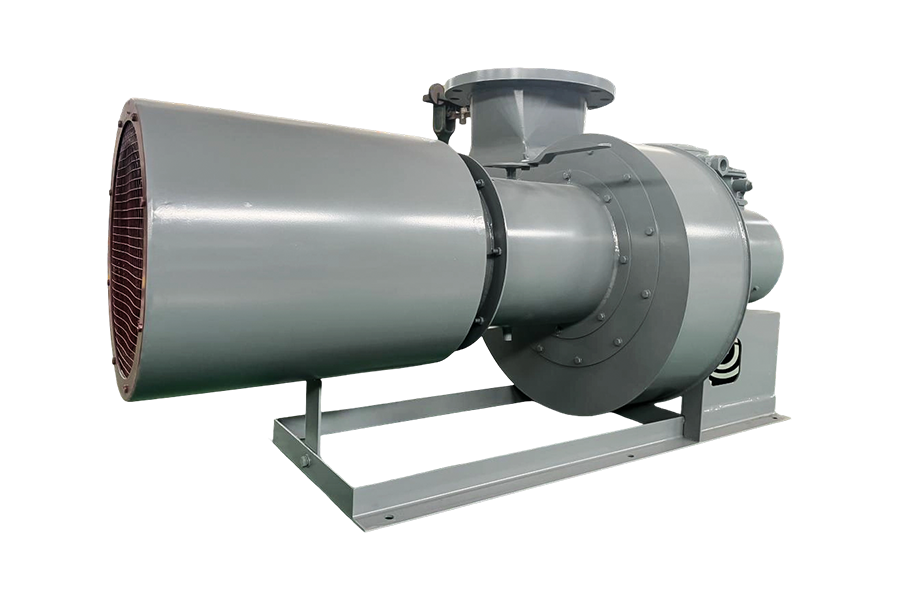
Anti-blower Product Name Air volume All-in Medium temperature Conveying medium Anti-blower 1000...
See Details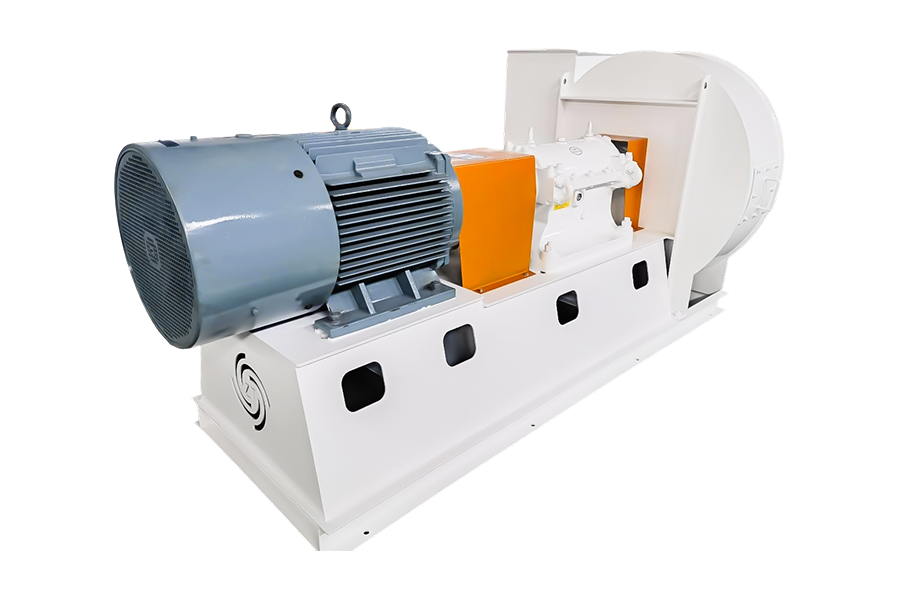
Category: Boiler System Centrifugal Fan Air blower Product Name Air volume Total pressure ...
See Details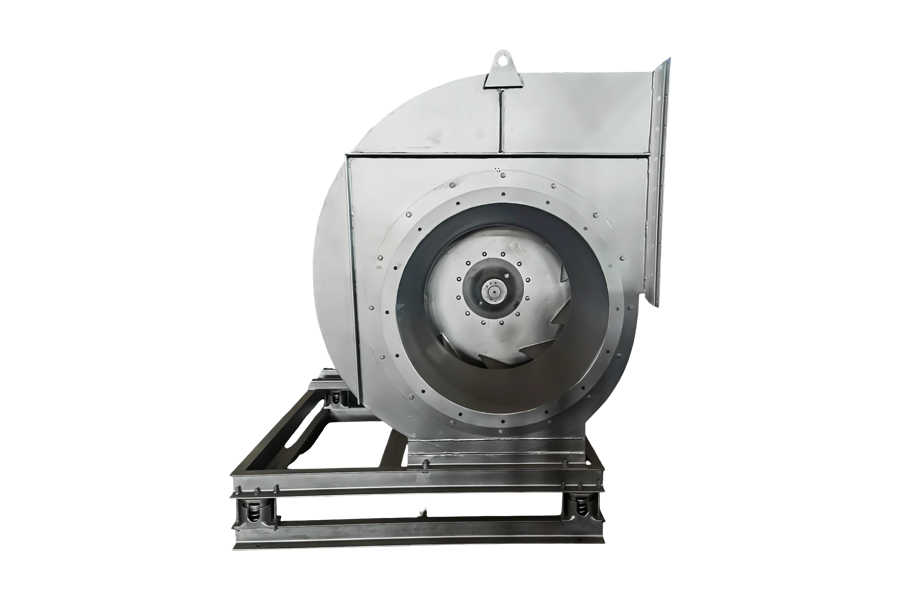
Category: Centrifugal fans for the coating industry Hot air circulation fan Product Name Air volu...
See DetailsMobile: +86-188 6157 1101
No.58 Wendong Road, Xushe Town Industrial Zone, Yixing City, Jiangsu Province, China

Copyright © JIANGSU ZT FAN CO.,LTD. All Rights Reserved.
Stainless Steel Centrifugal Fan Manufacturers


+86-188 6157 1101


 Contact Us
 Language
 English
 русский
 Español